


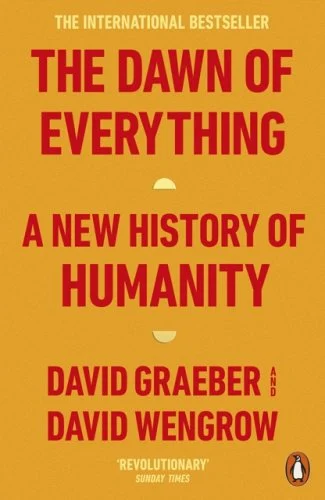
I posted about how The Dawn of Everything was blowing my mind on Facebook, but I really think it merits a bit more time and attention so here we go.
It’s written by archeologist David Wengrow and anthropologist David Graeber, so that’s two of my subjects of fascination combined for a start. But it ventures far beyond just another history book, literally, because it questions all the deep-rooted assumptions popular history has taught us about how human society developed.
We all know the story, and I’m guilty of buying into it too from what I’d read previously. In humanity’s early days we were peace-loving hunter-gatherers living in idyllic small groups.
If you prefer to listen, play the video below for a podcast version. Otherwise, read on.
httpv://www.youtube.com/watch?v=tHWzJKfeYDo
Until along came agriculture and civilisation and out the windows of those burgeoning societies went freedom, equality, and fairness. Or, conversely, we were bestial, violent savages until we discovered the stability of agriculture-initiated hierarchical and ordered societies. Either way, it’s a myth that no longer stands up to modern examination of the latest archaeology, or exploration of academic books and papers that have been side-lined because they refute this narrow view. For example, did you know there’s prolific evidence that Neolithic peoples in Great Britain tried agriculture, decided they didn’t like it, and went back to hunter-gathering?
This dangerous myth keeps us locked powerlessly in our current system believing there’s no alternative because, history tells us, our ancestors have already discovered this is the best and only way to go. In fact, our ancestors were incredibly creative and experimental, and their societal structures were myriad and shockingly fluid, as you’ll discover (probably with mounting awe and horror as I did!) when you read the many worldwide examples presented with a fresh perspective in this book.
In accepting this myth of inevitability, we’ve lost our sense of agency and freedom. Which begs the question, what is freedom anyway? Well, through their research the authors break it down into three essential freedoms, embraced by Native American tribes such as the Iroquois and Wendat who were both vocal in their mocking of our so-called civilised lifestyle when they first encountered Western Europeans. The contemporary diaries and reports quoted in this section of the book, all of which I’d never heard of, had me alternately howling with laughter and crying with anguish. There’s a story from the Native American tribes about how any potential council member would have to go through a systematic, ritualistic humiliation by the people to ensure they possessed the requisite humility and commitment to service. I’m sure I’m not the only one who takes great delight in imagining this particular process being enacted in my own country!
Where this book about the past lifts my heart and imbues me with greater hope for the future is in the naming of these three essential freedoms: the freedom to move away, the freedom to disobey, and the freedom to transform social relationships. Our ancestors, some of them, recognised the right and need of everyone to enjoy these freedoms, and it’s exactly what many of us are seeking to create now. In many forms and over many millennia, they structured and protected this freedom for themselves, which means we can do so again. We’ve already proved we have the ability to do it, and we now have the advantage of technology at our fingertips to assist faster dissemination and implementation of the necessary wisdom and organisation.
All I can say is read this book, be jaw-droppingly amazed, and then apply renewed hope to how you choose to help build our shared future. I’ll see you out there, making history with the assistance of the ancestors who also understood and promoted our right for freedom in the outer world as well as on the inner, spiritual planes. You might also like to read my recent article, connected to this subject A Thrutopian Evocation; the way through.

Semele Xerri
Latest posts by Semele Xerri (see all)
- Spiritual guidance October/November 2026: Find what lies beneath - October 7, 2026
- Spiritual guidance September/October 2026: Freedom is a soul-led life - September 8, 2026
- Spiritual guidance August/September 2026: Inner wisdom finds its voice - August 10, 2026

Follow me


Twitter (X) Feed

What connects love and war? Old wounds leave us in survival mode, fiercely defending our needs. What if we became curious about “the other” instead? Listening and seeking to understand is recognising our shared humanity. Peace takes practice, patience, and self-compassion.
🌿Feeling disconnected from yourself? Perhaps it's an invitation to pause, listen and find your way back.
Coming Home to Yourself is my six-week online journey of self-discovery, inner wisdom, and authentic living. Early Bird offer ends 14th October.
A Libra New Moon on 10 October begins a new lunar cycle through to 8 November. An invitation to look beneath the surface at the unconscious patterns driving us personally and collectively. Understand what moves you, and you can direct your passion wisely.
An autumnal misty morning, hedgerows glittering with hammock spiderwebs. I wanted to melt into one and simply reflect and dream. Autumn draws me inward: towards deeper thoughts, nourishing words, and quieter voices. Know yourself better. Something precious awaits if you listen.
When I talk about loving life, I don't mean just the good bits. I mean all of it. Joy and sorrow. Comfort and pain. Success and disappointment. Gain and loss. When you're anchored in the home of your heart and soul, you can meet life as it comes. You come home to yourself. 🌿